West Virginia
The Mountain State
Quick Stats
Map
Seal & Motto

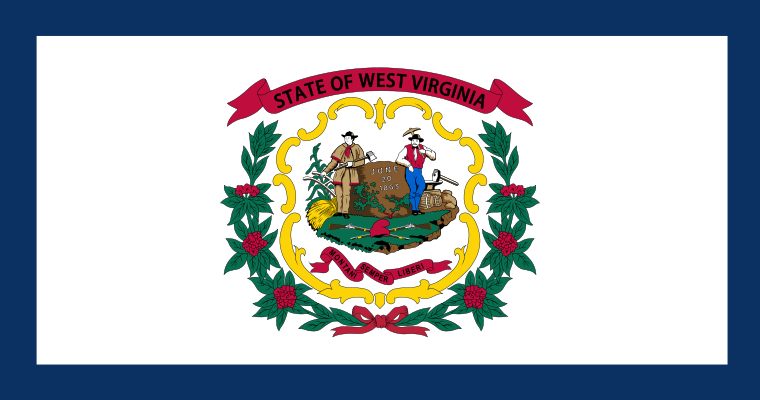
"Montani Semper Liberi"
Additional Information
Latin for "Mountaineers are always free," expressing the fierce independence of a people who broke away from Virginia rather than join the Confederacy.
Adopted 1863.
Population Growth
Overview
West Virginia, the 'Mountain State,' is a state of extraordinary natural beauty and quiet resilience. The only state entirely within the Appalachian Mountain range, it is a land of ancient rivers, deep coal-seam hollows, and dense hardwood forests where communities shaped by a century of mining culture have forged a character as rugged and dignified as the mountains themselves.
Geographically, it is uniquely isolated and does not share land borders with any other U.S. state.
Historical Significance
West Virginia officially joined the Union on June 20, 1863 — in the midst of the Civil War. It is the only U.S. state created as a direct result of that conflict, formed when the Unionist counties of Virginia refused to follow the state into secession. Its history is inseparable from coal — the mines that fueled America's industrial rise, the labor struggles of the United Mine Workers, and the mine disasters that mark its landscape and memory.
Top Cities & Hubs
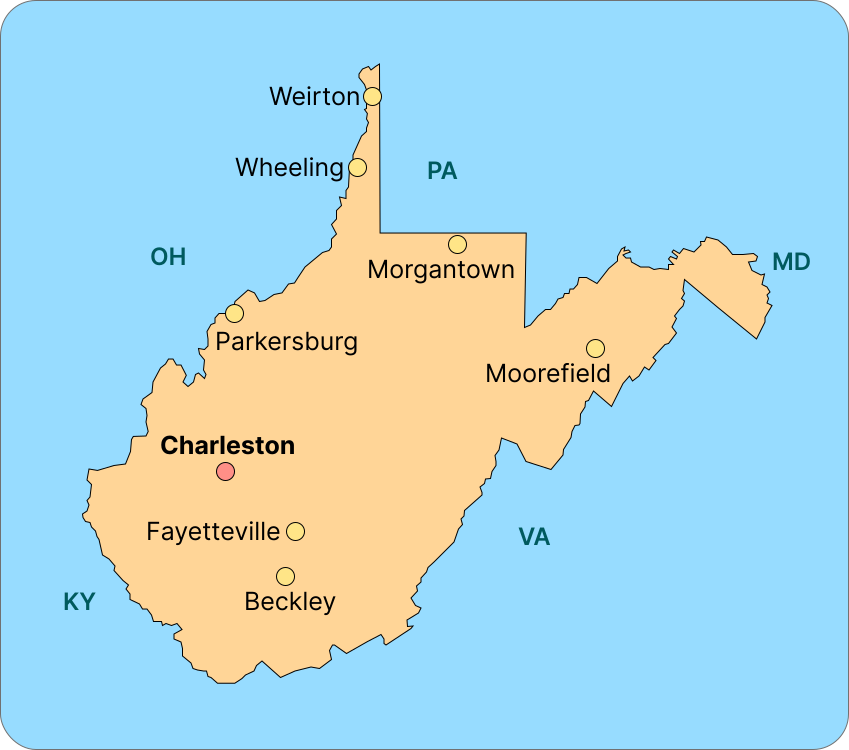
Charleston
Population: ~48,000The state capital and largest city at the confluence of the Elk and Kanawha Rivers, home to the gold-domed State Capitol designed by Cass Gilbert, a revitalizing downtown arts district, and the state's major government and commerce hub.
Huntington
Population: ~46,000A vital Ohio River city and home to Marshall University, known for its historic Pullman Square entertainment district, major healthcare complex, and the Marshall football team's inspirational recovery from the 1970 plane crash.
Morgantown
Population: ~30,000Home to West Virginia University, one of the region's premier research universities, a vibrant college-town culture, a cutting-edge personal rapid transit system, and a growing technology and entrepreneurship ecosystem.
Parkersburg
Population: ~29,000A historically important river city at the confluence of the Ohio and Little Kanawha Rivers with a rich industrial heritage in oil, chemicals, and glass manufacturing, home to Blennerhassett Island State Park.
Wheeling
Population: ~26,000West Virginia's original capital and the northern gateway to the state, known for its beautifully restored Victorian architecture, the Wheeling Suspension Bridge (once the world's longest), and historic role as a center of trade.
Key Landmarks & Economy
Did You Know?
- West Virginia is the only U.S. state to form by seceding from a Confederate state — its Unionist citizens refused to follow Virginia's secession in 1861 and were admitted to the Union in 1863 by Lincoln.
- The New River in West Virginia is one of the oldest rivers in the world — it actually pre-dates the Appalachian Mountains that surround it, making it a "superimposed" river that carved down as the mountains rose around it.
- The first Mother's Day service in the United States was held at Andrews Methodist Episcopal Church in Grafton, West Virginia on May 10, 1908, organized by Anna Jarvis to honor her mother.